Imagine waking up in Poland in the year 2000.
The country is mid-hangover. Your parents are casualties of the unemployment crisis, quietly plotting an escape west — Germany, maybe further — anywhere that pays in something stronger than hope. There’s a non-zero chance you’ll be left behind with your grandmother, a woman powered entirely by soup and Catholic guilt.
Every morning you march five kilometers through rain that feels personal, just to sit in classrooms that seem designed to prepare you for absolutely nothing. The only global celebrity on the menu is John Paul II, and while he’s undeniably a heavyweight, you’re not exactly feeling the seminary lifestyle.
You need a hero. Not a saint. Something else.
And then, somewhere between 2000 and 2001, a rumor cuts through the grey: some moustached guy has just won the biggest ski jumping tournament on Earth. Not just won — beaten the Germans, beaten the Finns. Again. The Germans!
This can’t be real.
Except it is. Poland is — improbably, gloriously — number one.
You’re hooked instantly. Adam Małysz becomes less an athlete and more a psychological condition. You’re too young to grow a moustache, but if there were a way to inject whatever he has directly into your bloodstream, you’d sign the paperwork immediately.
Meanwhile, kids in the UK are busy being David Beckham in FIFA. American kids are dropping 40 points as Allen Iverson in NBA Live. You, on the other hand, are staring at an Intel Pentium III that wheezes like an asthmatic pensioner if you ask it to open two windows at once.
You are technologically, spiritually, and culturally outgunned.
And then — like contraband smuggled across a collapsing empire — salvation arrives.
A classmate you actively dislike hands you a floppy disk. No ceremony. No explanation. Possibly an act of sabotage.
You run home anyway. Five kilometers disappear under your feet. You shove the disk into your prehistoric machine, double-click the first executable, and suddenly, in glowing, almost sacred letters:
“DELUXE SKI JUMP” © Jussi Koskela
Recently, I had the great pleasure of speaking with the creator of this monumental, cult video game.
I’m a little anxious before our online meeting. It feels like I’m about to meet a living legend — one of my childhood heroes. And you know what they say about meeting your idols.
Very quickly, though, I’m put at ease. The man greeting me on my screen is nothing but kind. He’s also drinking a glass of milk, which happens to be my beverage of choice as well — though I mix mine with hazelnut vodka. I decide not to ask if he uses the same technique.
Instead, I ask about his memories of making games. I know he started very young. What was it about games that captured your imagination? What motivated you to create your own?
J: I enjoyed playing games, so for me the natural next step was to create my own. Many kids dream about making their own game while playing something, so in a sense you could say I just followed my dreams. (…) The first functional game I created was based on the He-Man character I used to watch on TV. In my game, He-Man was walking around, and when he encountered a spider, you just had to press F1 to swing a sword. I created it in the BASIC programming language. I had a manual, but it was written in English, so I didn’t really understand it as a kid — but that didn’t stop me from copying and pasting example code and figuring out what different lines did. You could say I always wanted to control a computer in some way.
What was your creative process like when you were making Deluxe Ski Jump?
J: The process was very ad hoc at that time. It was a hobby project, so I could experiment and play around with it, but at the same time I was obsessive and trying to make it almost too perfect. I was still living with my parents, and they were like, “Okay, it’s good enough — release it,” but I didn’t see that as an option.
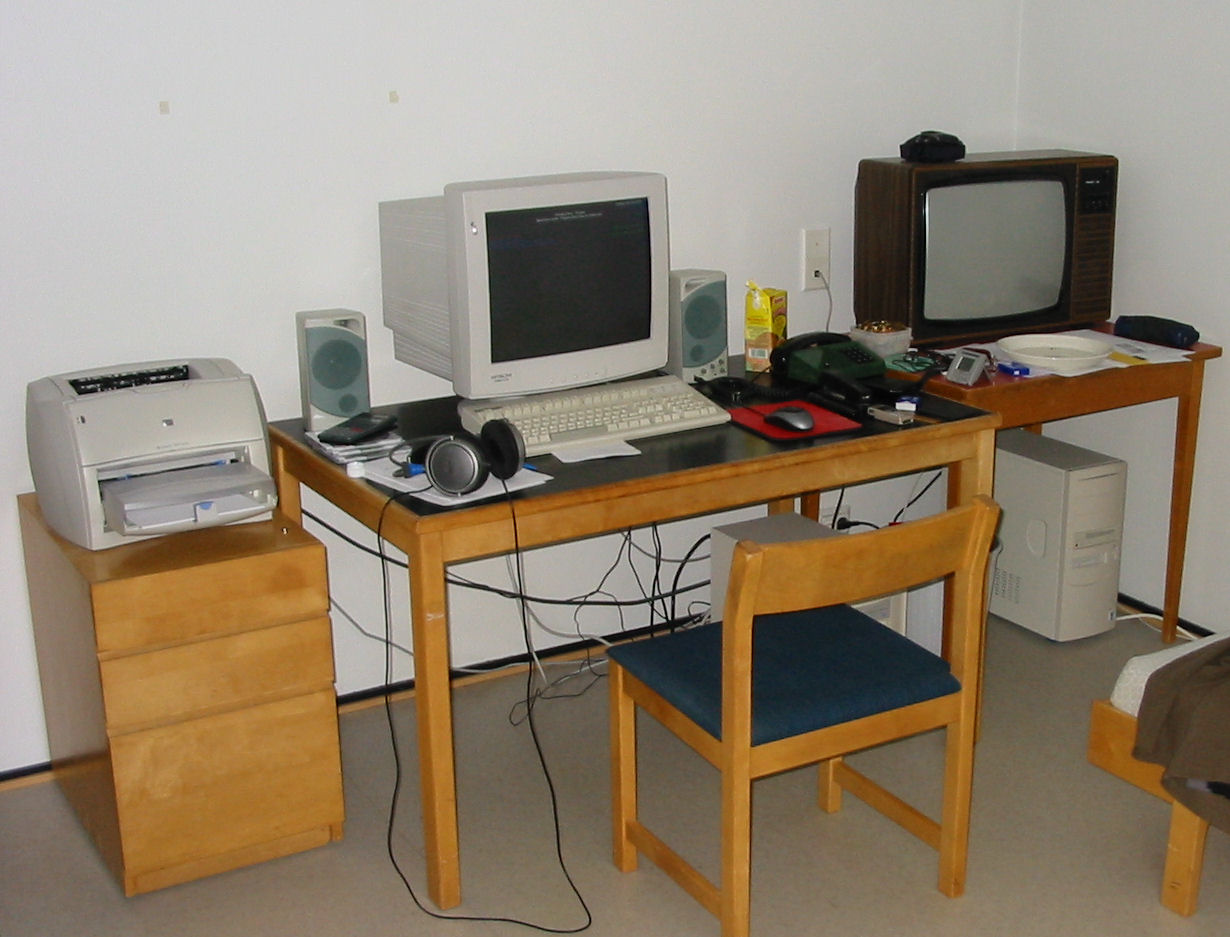
Jussi Koskela’s computer setup, early 2000s
If Deluxe Ski Jump had completely failed, do you think you would have continued making games anyway?
J: Difficult to answer. As I mentioned in past interviews, I finished the game in three months, and right after that I went to do my one-year military service, followed by six years at university. There’s a possibility I would have needed to earn more money to support my studies — some kind of summer jobs — which could have left me with less time for game development. I was in a position where DSJ was already out, I had some stable income, and I could focus on updates and sequels. In different circumstances, I can imagine I might have ended up doing something completely different in life.
I notice that Jussi is very modest in his answers. He casually mentions that he created his first game at the age of nine, as if there’s nothing extraordinary about it. I try to remember what I was doing at that age. I have vague flashes — something about a song from primary school teaching me how to brush my teeth properly.
I’m curious about the moment he realized the game had become something bigger than just a game.
J: When I went for my military service, I left some instructions for my father on what to do if there was interest in the game. I sent a demo version to a few Finnish gaming magazines and hoped for the best. People started ordering the game by sending cash in envelopes to my house or paying via bank transfer. The first feeling of success came by accident — I went to withdraw some money from an ATM and saw that four people had already bought the game. That felt amazing. But it wasn’t until my first visit to Poland, when I met hundreds of people who all shared similar stories — how they played the game in school IT classes or at home, and how much it meant to them — that it really hit me. It was something more.
What do you think DSJ tapped into psychologically that other sports games didn’t?
J: I think Deluxe Ski Jump is timeless. It looks old, but somehow it doesn’t feel old. Today, many indie developers create pixel art games, which resonates with DSJ’s graphics. Another big part of its longevity is replayability. There’s no single formula for a perfect jump — you can do it in many ways, and you never know when you’ll beat your record.
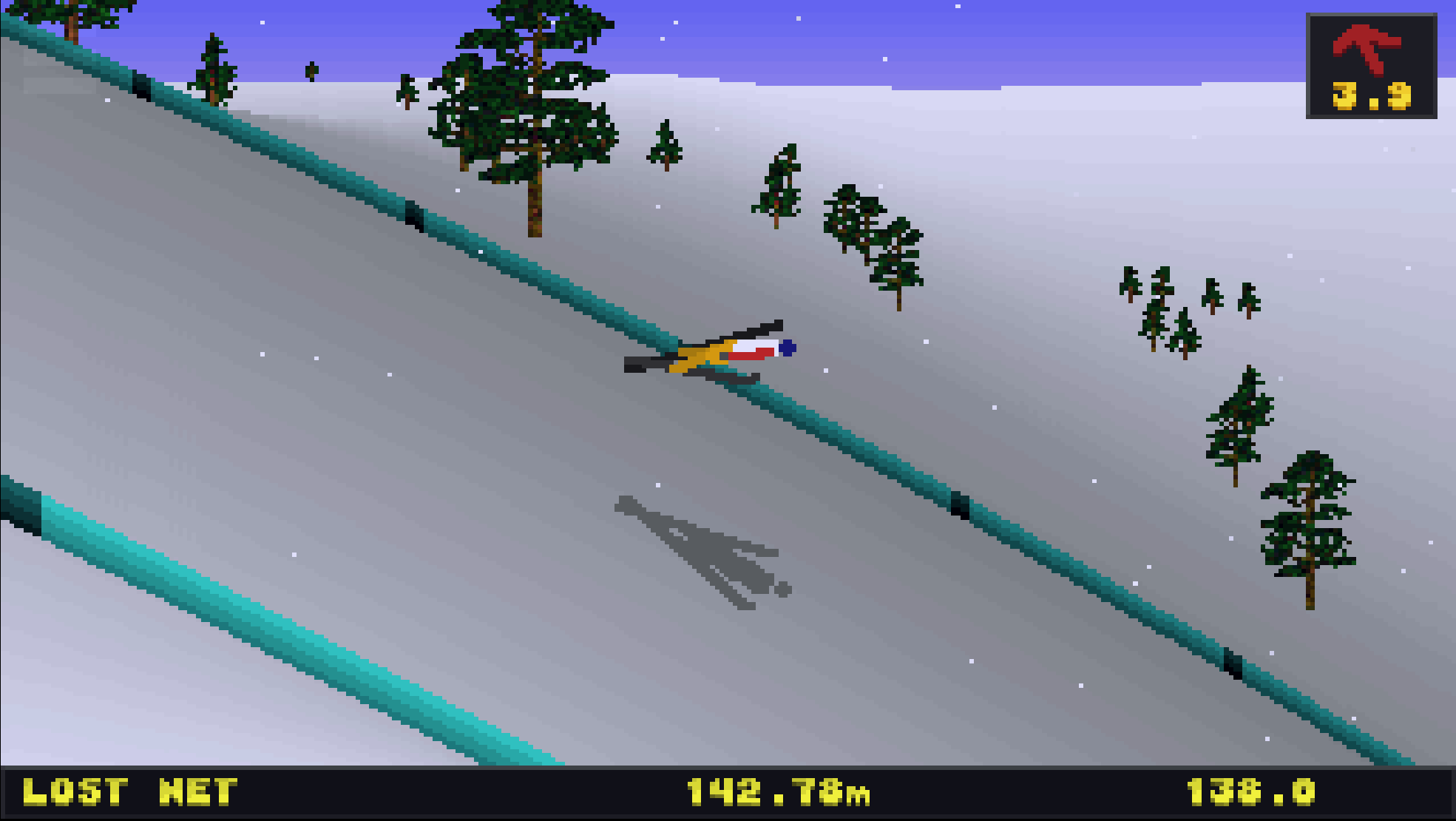
Deluxe Ski Jump — in-game screenshot
I want to know more.
Why do you think players are willing to spend days — or even weeks — chasing a slightly better personal record?
J: I think, in some way, I was able to capture the feeling of flying. From the takeoff — when the player has to click both mouse buttons at the same time — through controlling the jumper in the air, all the way to landing, you are fully immersed in the jump, emotionally and physically.
Our conversation drifts to how long DSJ has been on the market. Jussi mentions it has been almost 27 years since its initial release. The number throws me off. I knew the timeline while preparing for the interview — but hearing it out loud hits differently.
You’ve stayed very active with the community — appearing in long tournament streams, organizing meet-and-greets, updating the game, allowing modifications. How did you build such an incredible community around DSJ?
J: This is a tough one. I’ve never considered myself a leader of a community. I think communities are built by passionate players who want to contribute more than just playing. They create websites, mods, and more. There’s extraordinary talent among players, and if a game is good enough, the community will grow on its own. You just need to give them freedom — and not sue them later…
For many people, you’ve become something of a cult figure because of DSJ. Did that come with any pressure?
J: Sometimes I feel pressure. Expectations can be very high, and as a solo developer it’s difficult to meet all of them — especially during the winter, when the ski jumping season is on.
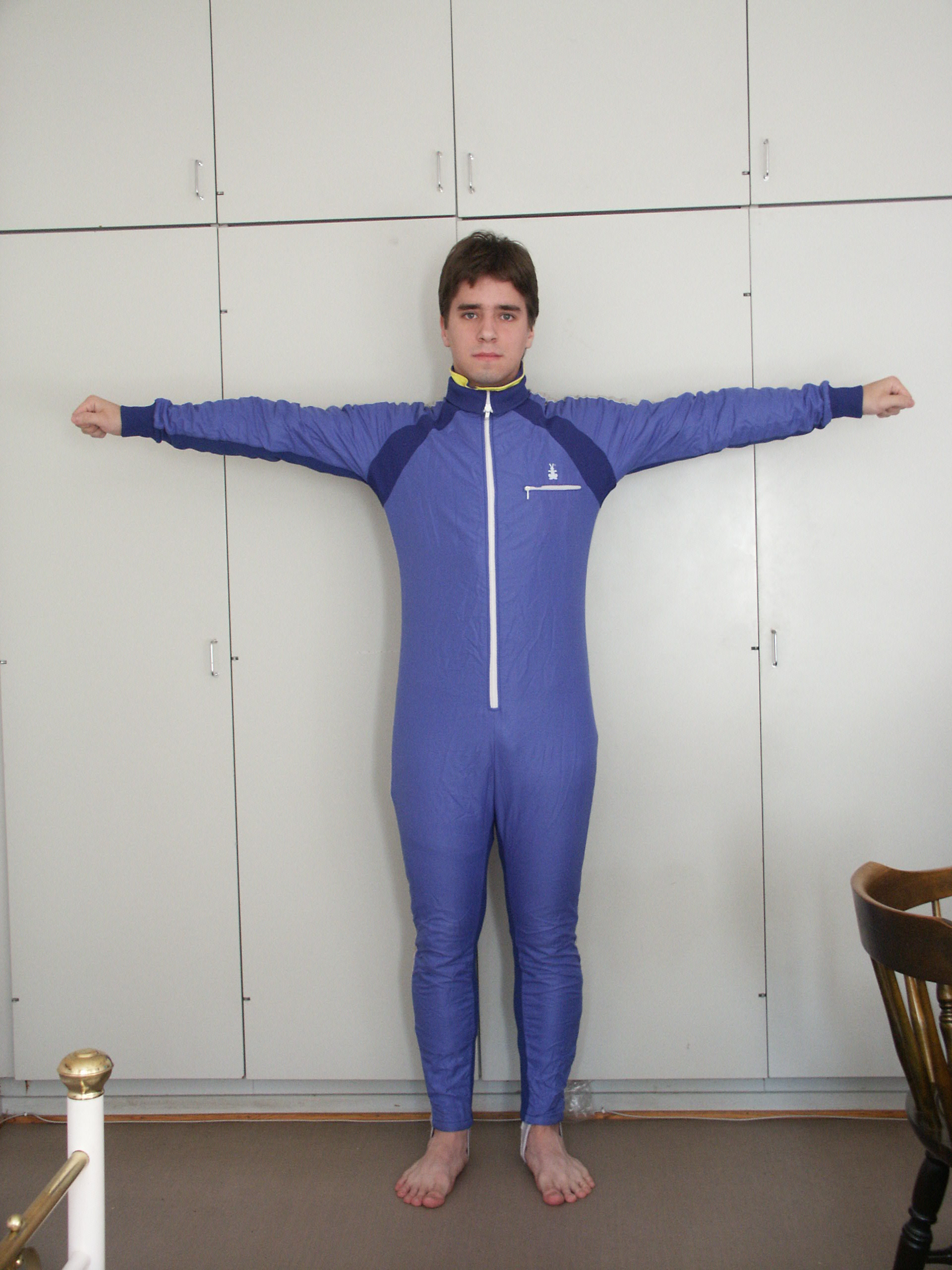
Self-modelling for Deluxe Ski Jump 3
So far, the conversation has been fantastic. Funny and insightful, but I know I have to ask about piracy. I just hope he doesn’t hold a grudge, considering how widely the game circulated on the Polish black market.
Back in the early 2000s, piracy was widespread, and DSJ was heavily shared. How did you feel about that at the time? Has your perspective changed?
J: Of course it was frustrating, as it was my only source of income. But in the long run, we probably wouldn’t be having this interview if the game hadn’t been pirated so much. Even back then, if I had the choice between making a few million people happy or earning money from a few hundred, I would still choose the first option.
We talk a bit more about this — about access to culture, socioeconomic realities, and why copyright felt like a distant concept in Poland at the time. Jussi is very understanding and shares a similar perspective to mine. I quietly hope that everyone who didn’t own a legal copy back then does now.
Time to move on.
There’s a joke online that if Nokia had preinstalled DSJ on their phones, the iPhone might never have existed. Did you ever receive serious offers from bigger companies?
J: I remember a big Finnish mobile game developer trying to persuade me to create a DSJ version for Nokia phones — this was before the iPhone — so who knows how that could have turned out.
Why didn’t it happen?
J: At that time, Nokia phones weren’t very advanced. I didn’t think the game would work properly — it would probably run at around 10 FPS and be controlled by stiff buttons. It would have been very difficult to capture the same feeling as on PC.
Did you ever feel pressure to make DSJ more commercial or mainstream?
J: Not really. I never spent any money on advertising — it was all word of mouth or my own website. Ski jumping is a niche sport, and trying to sell it to someone who doesn’t feel it just doesn’t work.
Do you think DSJ could succeed if it launched today, in an algorithm-driven, social media-heavy world?
J: Technically yes — it’s easier now to reach people through social media. But at the same time, the market is saturated, and people don’t have the same patience or attention span. After a few crashes, they might just move on to another title.
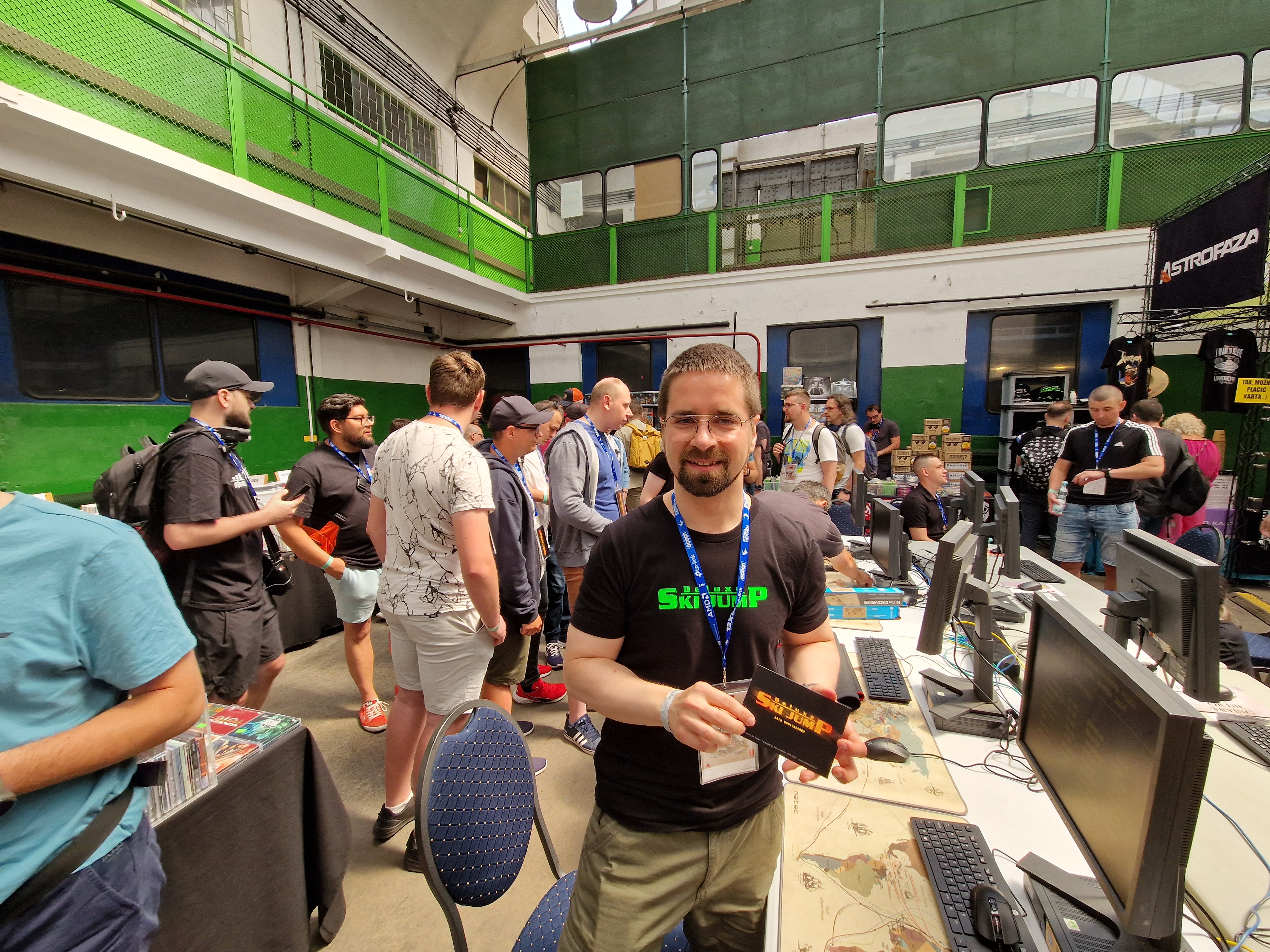
Jussi Koskela at Pixel Heaven, Warsaw, 2024
I’ve spent over an hour on a video call with Jussi. I learn that he created all the sound effects using only his mouth. That he had to take a week off from military service just to legalize his work and register a company. That there is a special jumping technique called “gibbon style” that helps you go farther.
I ask about his future plans, but he admits he’s not someone who plans too far ahead — which, by now, feels perfectly consistent.
I begin to wrap up. I thank him — for the conversation, for the game, for everything.
One last question: what does it mean to him when people say DSJ was a big part of their lives?
J: It’s very touching. No doubt about it. Especially when I meet people and talk to them directly — it means a lot. I remember my first public visit to Poland as the developer of Deluxe Ski Jump, for the 25th anniversary. After all those encounters, I went back to my hotel room and cried for ten minutes straight before going to sleep. I was just so happy that I had been able to bring so much happiness to people. It meant the world to me.