"Let him who never pirated anything from the internet cast the first stone" may not be an actual biblical quote, but it perfectly captures the moral flexibility of the early-2000s internet, when copyright law felt more like a suggestion than an actual legal framework. Like everything “good” in this world, piracy — and I am deliberately avoiding discussions about copied CDs being sold like narcotics at dodgy markets — went mainstream in the USA with the creation of Napster.
You might remember it if you were alive back then, or from years later while watching The Social Network, when some college girl wakes up in a dorm room next to Justin Timberlake playing Sean Parker — the co-founder of Napster — and realizes he hasn’t quite brought sexy back, but instead an entire catalogue of illegal MP3 files.
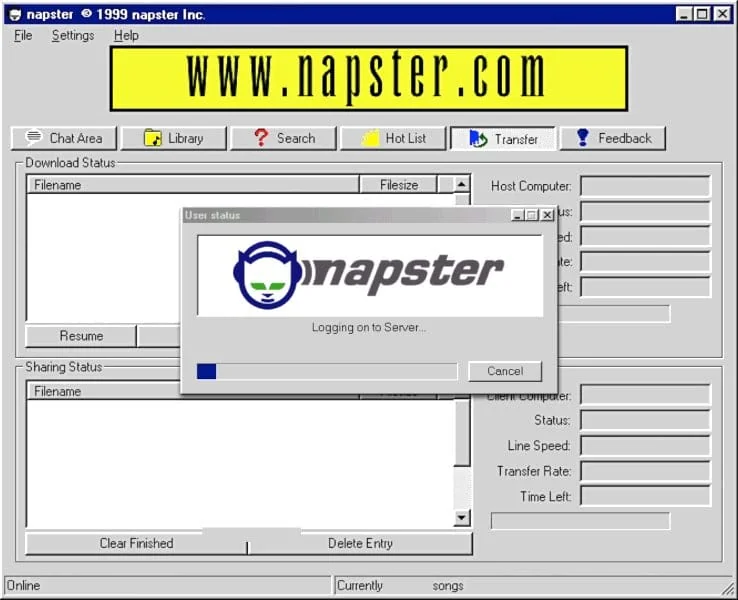
Source: Reddit
And even though Napster’s core idea was basically the same as its successors, its mythology remained mostly tied to music. Which was fun, sure, but there are more things in this world to steal than Limp Bizkit songs. That’s where eDonkey2000 and eMule come in.
These weren’t the only platforms doing this sort of thing — there was also Kazaa and LimeWire — but if I had to point at the spiritual leaders of early peer-to-peer piracy, it would definitely be the two horse-adjacent animals.
The core idea behind P2P — or peer-to-peer sharing — was built on beautifully simple logic: users shared files directly between each other instead of relying on one central server. A strangely utopian philosophy, somewhere between digital communism and collective criminal enterprise. If I had something, you could have it too.
The key difference from Napster was decentralization. A word that today sounds permanently attached to cryptocurrency podcasts and men explaining blockchain at parties nobody invited them to. But the concept itself was fairly simple. Napster still relied on a central system keeping track of who had what. Think of it as one giant illegal library with a receptionist. You searched for a song, Napster checked its records, and pointed you toward the random guy in Ohio sharing a low-quality MP3 of Eminem.
eMule worked more like a black market spread across thousands of computers simultaneously. No single place controlled everything. Instead of downloading one file from one person, users downloaded tiny fragments of the same file from dozens, sometimes hundreds, of strangers around the world. Your pirated copy of Shrek 2 could arrive in pieces from Germany, Poland, Brazil, and a deeply concerning desktop computer running nonstop in suburban Belgium since 2004.
Source: eMule Project
Sounds almost too good to be true. Well, yes, because it absolutely was not that easy. Sometimes the movie, game, or whatever cultural artifact you were attempting to steal simply refused to download at all. After a few hours — or days, in more dramatic cases, especially if you were hunting for something niche — the progress bar could freeze forever at 97% because no one was sharing the remaining pieces of the file anymore.
Imagine downloading GTA III for several straight days on your glorious 128 kb/s connection only to discover the download could never actually be finished, and nobody could explain why. This happened far more often than you would think, but honestly, that part was manageable. You simply returned to the search bar and tried another version.
The truly traumatic experience came after the file finally downloaded and you had to discover what exactly you had brought into your home. Like Schrödinger's cat, the file existed in all possible states until you opened it.
Usually, if you knew what you were doing — followed uploader ratings and picked files with the highest number of seeders (people sharing the file) — you were relatively safe. Otherwise there were four possible outcomes.
Let’s say you searched for Harry Potter.
1. You got Harry Potter as intended.
2. You got a virus.
3. You got low-resolution pornography renamed purely for clicks.
4. You got an obscure Czech film about a boy communicating with squirrels. Technically still magic, just not the kind Warner Bros had in mind.
Malware itself was not even the worst part, mostly because it became relatively easy to detect. Either you had an antivirus program — almost certainly pirated too — or you learned to fear suspicious file extensions with religious intensity. If the file ended with Harry_Potter.avi, you were probably safe. But God help you if it looked like Harry_Potter.avi.exe.
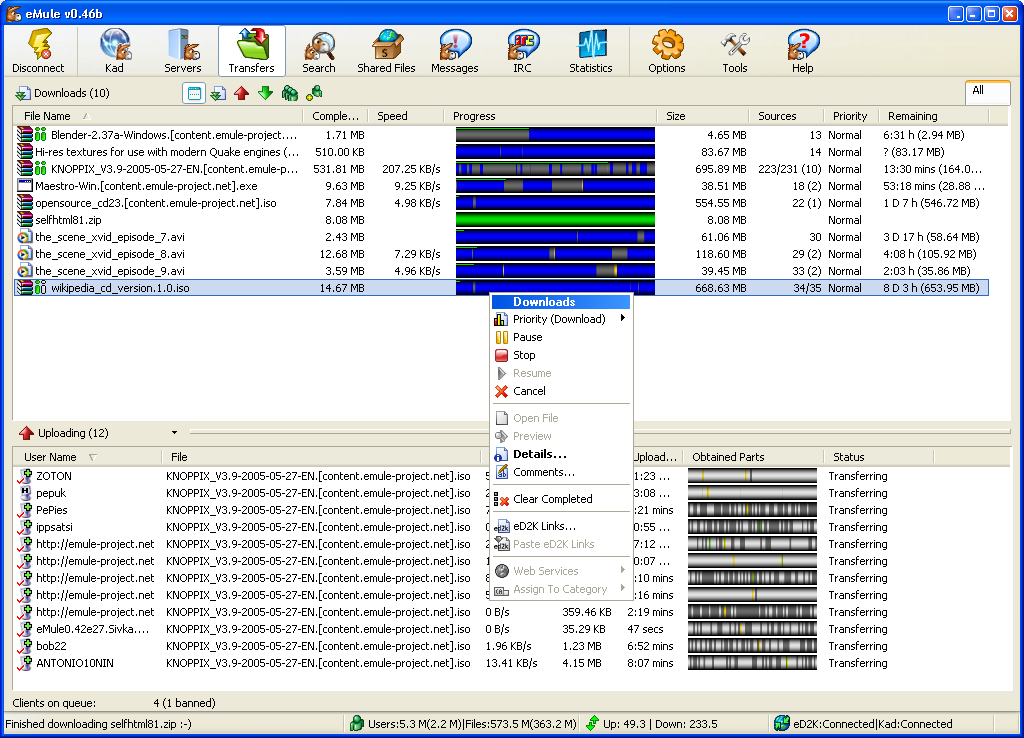
eMule interface. Source: eMule Project
I still occasionally wonder how many viruses I collected during my darker years as a 12-year-old with unrestricted access to global culture. Probably quite a few. Then again, what exactly was the strategic value of hacking my family computer? Hopefully whoever gained access enjoyed my Metallica discography and folder full of Jessica Alba bikini photos.
There was also an entire strange poetry to file naming conventions during the golden age of piracy. Nothing was ever simply called Movie.mp4. Downloaded files looked less like entertainment and more like classified military operations. The.Matrix.Reloaded.REAL.FINAL.DVDRIP.XviD-FGT.avi suggested not only that the file was legitimate, but that several international incidents had already taken place during previous failed versions. Words like “REAL”, “FINAL”, “PROPER”, or “LIMITED” appeared with such frequency that you slowly lost all understanding of what those words actually meant. Sometimes uploaders added “NOFAKE” directly into the title, which paradoxically made the file feel significantly more fake. The truly terrifying part was when a movie title ended with something like .rar.zip.iso because it meant you were about to unpack the same file six consecutive times like some cursed digital Russian doll. Looking back now, piracy communities developed an entire underground language entirely based on desperation, bad compression, and mutual distrust.
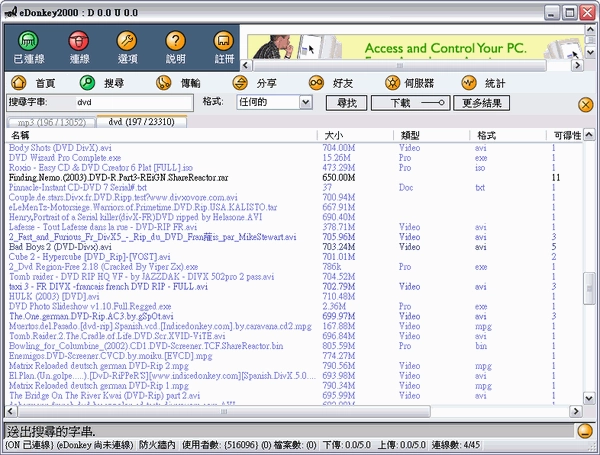
Source: BaiduWiki
During research for this article, I ran old P2P clients on a Windows XP machine just to see how the interfaces looked and whether they triggered any buried memories. Oddly enough, they did and didn’t at the same time. What surprised me more was discovering that some servers are apparently still alive. Unfortunately, most of them now contain the word “SEX” somewhere in their names, which felt less like an invitation and more like a warning from the universe, so I chose not to investigate further. The knowledge that people still use these systems is already unsettling enough. And to be honest, I am not entirely sure I want to know who those people are.
After all these years, I still cannot fully decide what I think about early internet piracy. Morally, it was obviously wrong. No serious debate there. But sociologically? That becomes more complicated. Is access to culture more important than the legality of how that access is obtained?
I often think about my childhood and the people around me growing up in rural Poland at the beginning of the 21st century. The experience was strangely specific to that moment in history. According to CEIC and Statistics Poland data, the average household income per capita in 2000 was around $1,686 per year. Piracy became our shortcut to not feeling completely disconnected from the rest of the world.
Either you got lucky and watched The Lord of the Rings: The Fellowship of the Ring during a school cinema trip, or your parents successfully navigated the chaos of post-communist economic transformation and could afford DVDs, video games, and a computer that did not sound like agricultural machinery.
I think most people from that era have their own stories and their own reasons. I only hope that anyone who could genuinely afford cinema tickets and legal DVDs back then did not abuse illegal downloads too much. And if they did, I sincerely hope at least one of their movies turned out to be extremely disturbing pornography or porn.avi.exe.
To conclude, I will leave you with the official response sent by the founders of The Pirate Bay — the most iconic site of that era of internet piracy — after receiving a legal complaint from DreamWorks Animation regarding unauthorized use of copyrighted material.
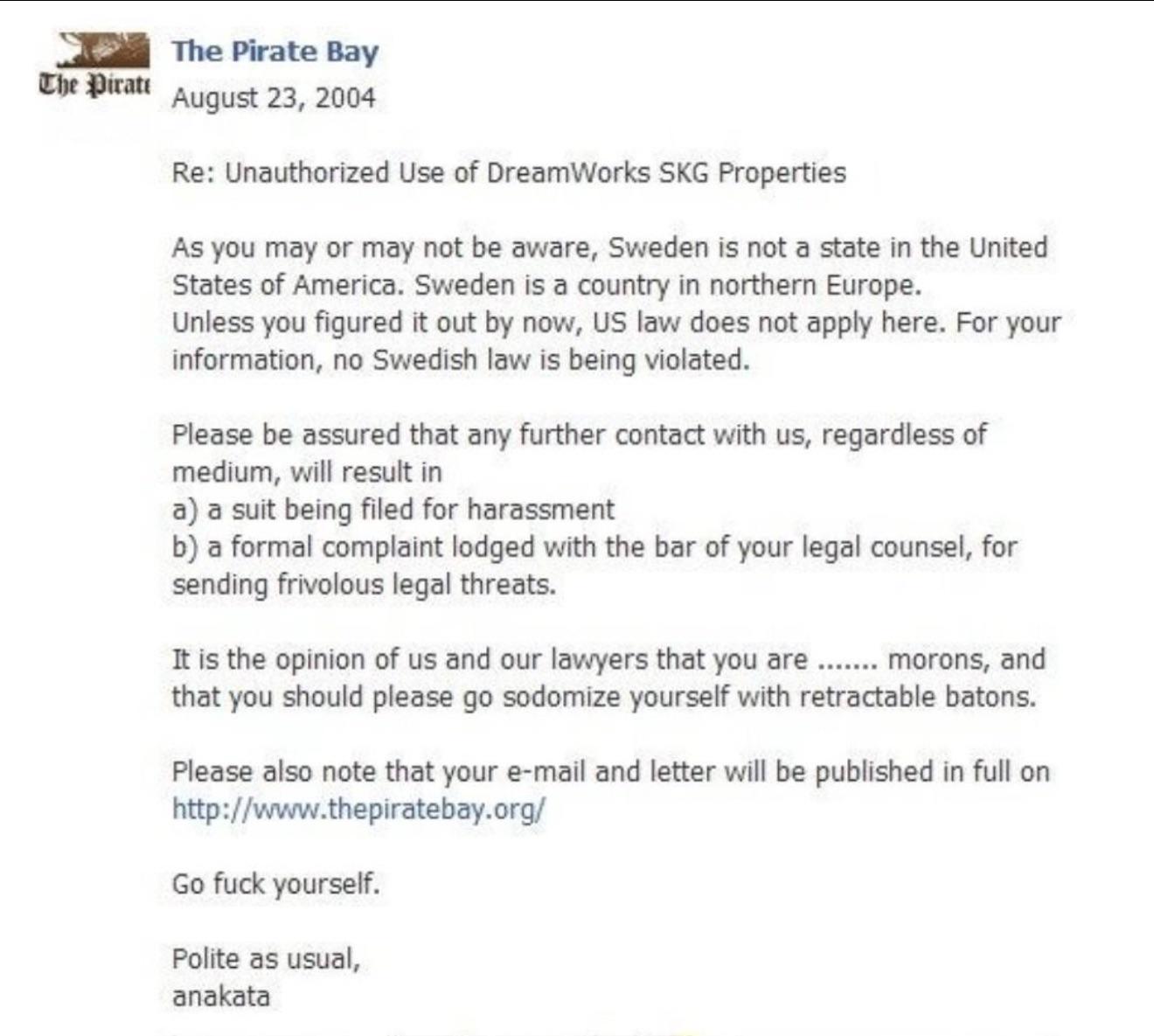
Source: Reddit
The internet was a very different place back then.