
Click! issue 3/2000 cover
Source: Internet Archive
The main drawback is the need to constantly monitor Sims and repeat similar commands every day, which can eventually become repetitive.
Almost three decades later, and we are not bored at all...
There is a strange feeling that comes with rediscovering old reviews of games that are now considered industry defining. Not nostalgia exactly, and not irony either, more like a quiet dissonance. You read a few paragraphs and suddenly realise the writer is describing something you know as enormous, culturally embedded, endlessly expanded, as if it were just another curious experiment on a magazine page.
The distance is almost uncomfortable. We already know what The Sims became. The reviewer does not.
And that gap is the entire point.
This particular review from Click! Magazine, issue 03/2000, was written by Andrzej “C(w)alineczka” Cwalina, a nickname that even today feels like it belongs to a different era of gaming journalism.
Reading it now, it is hard not to feel a slight contradiction. Because The Sims is treated here with a kind of plain factuality that borders on indifference. Not hostility, just absence of fascination.
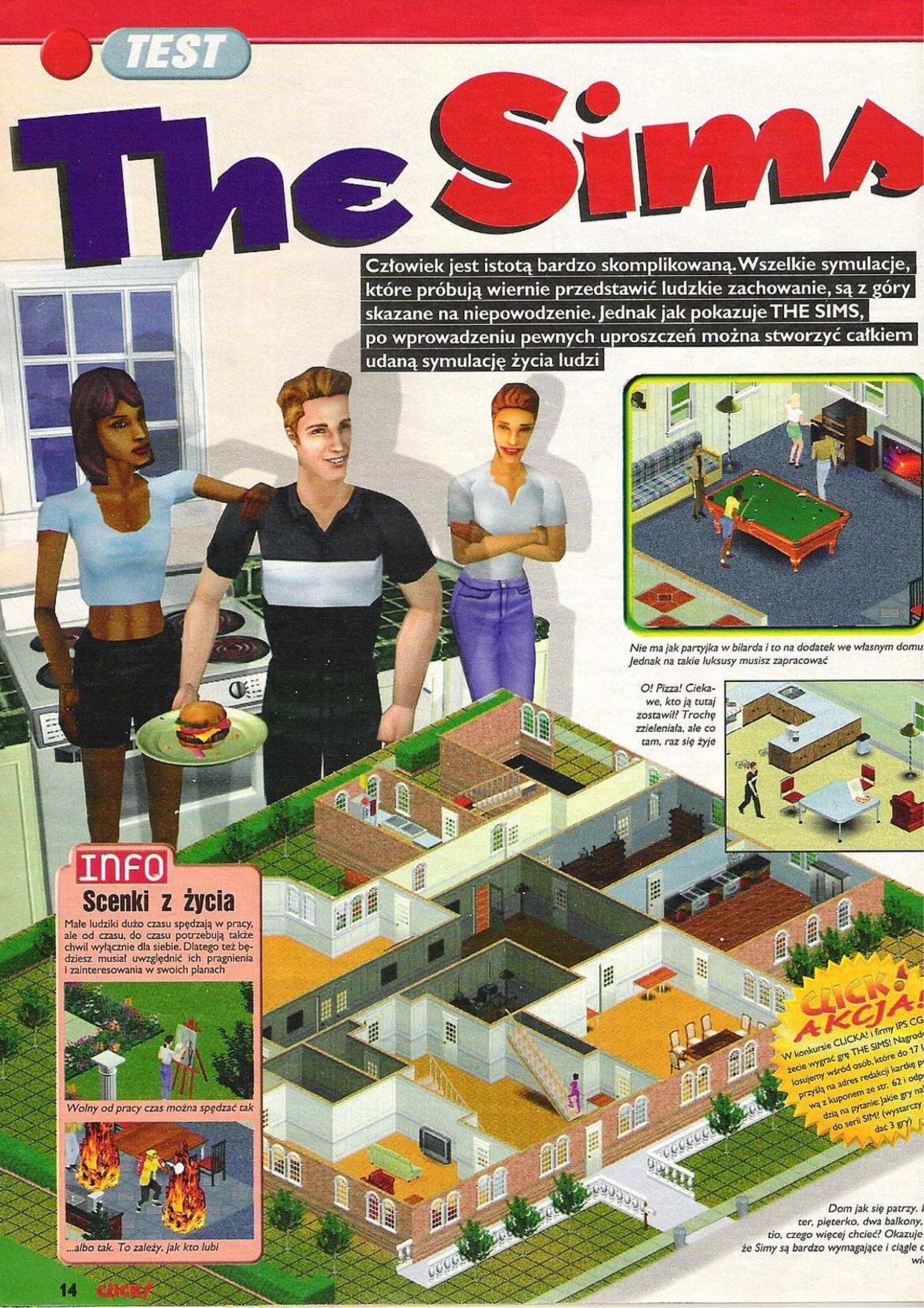
Click! 03/2000 review
Source: Internet Archive
The opening frames the entire experience in very controlled, almost instructional terms:
In Maxis’ newest life simulation, you are fully responsible for the fate of the Sims – virtual people. It is entirely up to you whether they will be happy and satisfied with their lives.
It is accurate, but flat in a way that feels almost intentional. As if the game is being translated into something more manageable, stripped of its potential weirdness.
What follows is essentially a catalogue of mechanics. Hunger, sleep, hygiene, social interaction, careers, house building, everything is presented cleanly and methodically. The review explains what the player does, what the Sims need, and what happens when those needs are ignored.
The problem is not that any of this is inaccurate. Quite the opposite. Everything described here is correct. The problem is that the review rarely ventures beyond description. It never really stops to ask why these systems might be interesting, or why players could become obsessed with them.
Looking at it from today’s perspective, it is hard not to wonder what shaped this writing. Was there genuinely nothing in that game that triggered curiosity at the time?
One of the few moments where the text acknowledges something unusual is when discussing Sim autonomy:
Sims are not completely mindless. Once they finish assigned tasks, they will look for other activities on their own.
Today that sounds like a throwaway observation. In 2000, however, this was one of the most fascinating aspects of the game. The idea that digital characters could exhibit behaviours that were not directly scripted by the player was still relatively novel to mainstream audiences.
Yet even here the review quickly moves on. There is little sense that these systems might generate stories, create attachment, or become the reason people spend hundreds of hours inside virtual households.
What is missing, perhaps more than anything, is the sense that this system could be strange, expressive, or unexpectedly absorbing. Today, we tend to associate The Sims with emergent stories, accidental comedy, and long form player attachment. None of that is really visible in this reading.
Instead, the review stays firmly in description:
The game does an excellent job of describing the needs, abilities, and personalities of its virtual people.
Describing feels like the key word. Not simulating in a way that invites imagination, but cataloguing behaviours.
And that is where the modern reading becomes slightly uneasy. Because we know what was not yet visible here. We know what this system would evolve into once players started bending it, breaking it, storytelling through it.
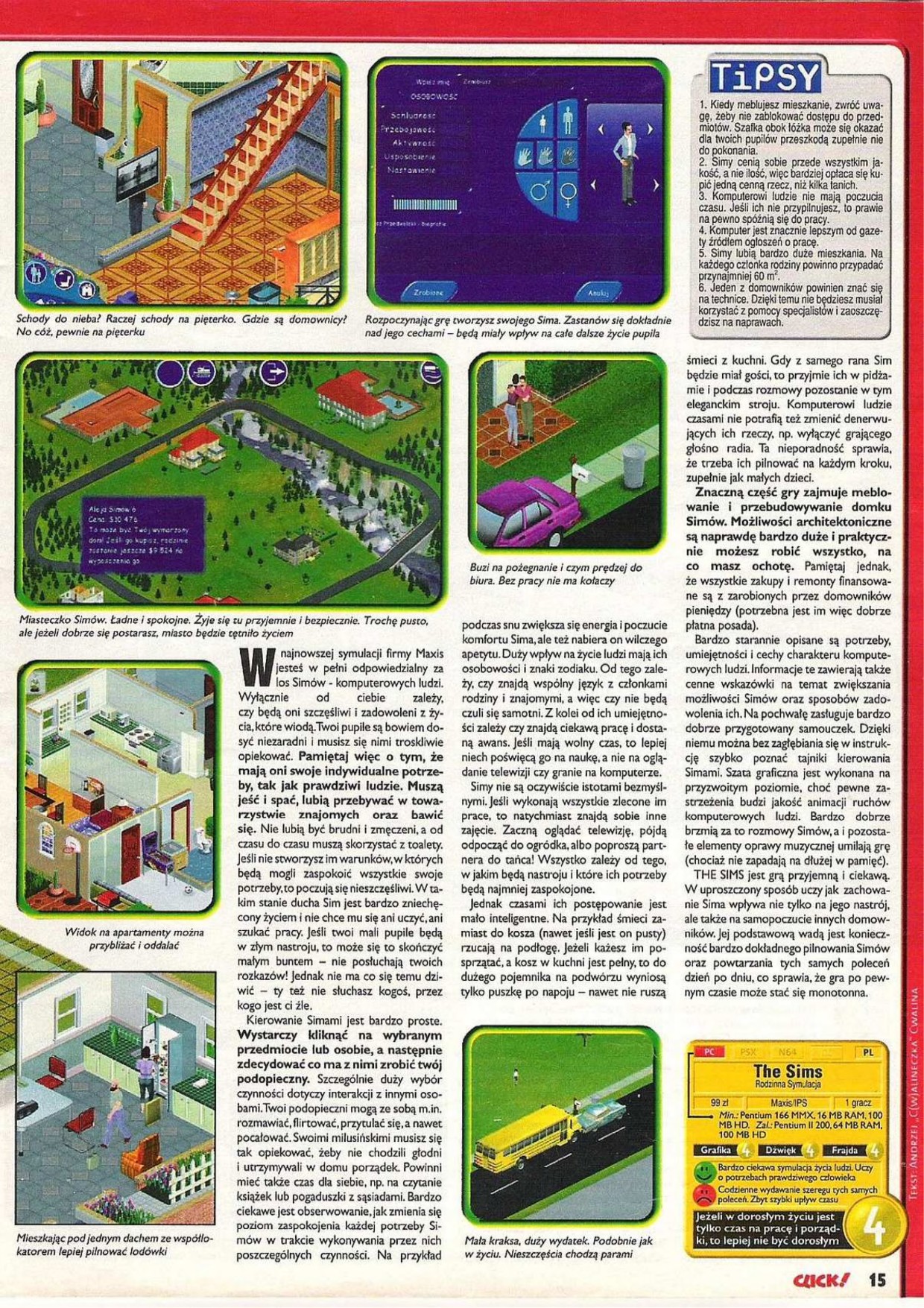
Click! 03/2000 review
Source: Internet Archive
Personally, I remember the buzz around The Sims around the time it was releasing. I remember a copy arriving at my household somewhere near the global premiere. It quickly became something very present in my social circle. My friends, classmates, relatives and very likely even their parents were all, in one way or another, drawn into Maxis’ production.
That is why reading this review more than 26 years later feels slightly surprising. I keep coming back to the same question. How was it possible to miss so much of what this game would become? Was it simply one of many titles passing across the reviewer’s desk that month, or was there genuinely nothing in it that felt worth fascination?
The score was divided into three categories: Graphics, Sound, and Fun. In each of them, the game received a 4. Out of what, I have no idea. I would assume out of 6. The categories themselves already feel very limited, very contained, much like the review itself.
Graphics, Sound, Fun. A clean triad, almost like a checklist rather than an attempt to describe experience.
I have no idea how I would have interacted with this review back then. Whether it would have dampened my enthusiasm or, quite the opposite, made me even more curious. Today I can at least rate the text itself in the Fun category as a solid 2 out of 6.
Curated for Lost Net
Source: Click!, Issue 03/2000